

A doctor once said to me, “You will run again.” This was 10 days after
my stroke. During the next many months of healing, I never forgot those
words. I did run again.
Doctor’s words are powerful.
When an ICU doctor told my family my brain was very damaged and I might not recover, they took his words very seriously. My sister went into this doctor’s meeting thinking, “This is where we find out everything.” His words were incorrect.
I am not saying doctors cannot be mistaken. But when it comes to the stroke survivor’s brain, it seems that so many doctors say the wrong thing. The brain can do amazing things. Doctors should learn about stroke rehabilitation in the 21st century. Doctors should learn about neuroplasticity.
Wiki says:
Neuroplasticity, also known as neural plasticity, or brain plasticity, is the ability of neural networks in the brain to change through growth and reorganization. It is when the brain is rewired to function in some way that differs from how it previously functioned. These changes range from individual neuron pathways making new connections, to systematic adjustments like cortical remapping.
https://en.wikipedia.org/wiki/Neuroplasticity
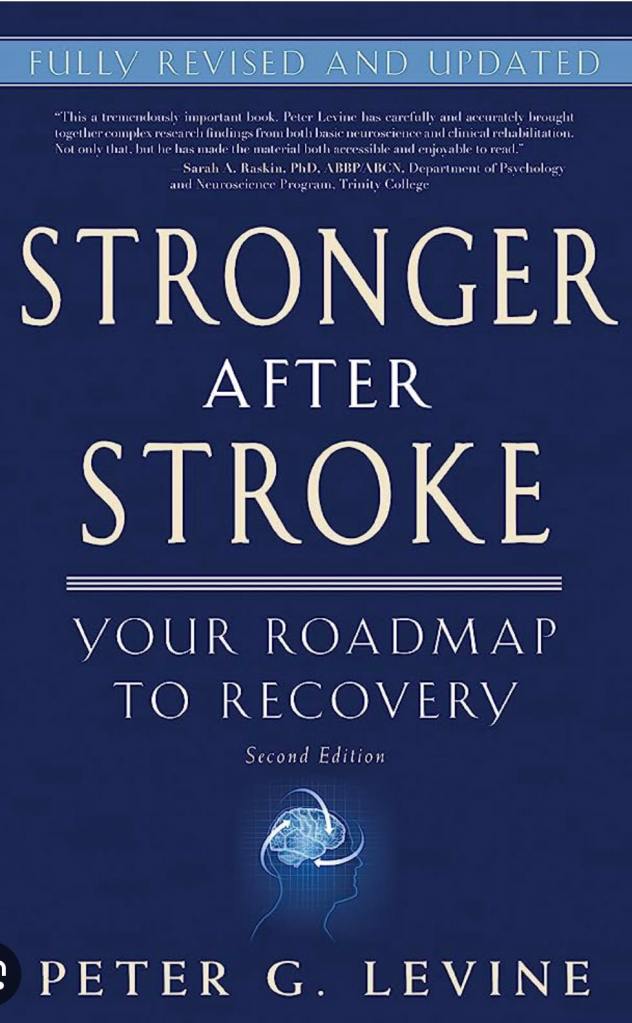
In the book Stronger After Stroke, author Peter G. Levine says:
“- There are approximately 100 billion neurons (nerve cells) in the brain.
– A typical stroke kills less than 2 billion neurons. “
That leaves us with 98 billion neurons! 98 billion neurons to rewire and make different connections so that we can talk, walk, recover.
I have heard many doctors and health care professionals say that stroke recovery ends after three months or six months or one year. Doctor’s words. This is entirely untrue.
Seven months after my stroke, I was lucky enough to find a stroke group on Facebook. I wish I had found it sooner! People from all over the world talk about their struggles, their victories; about all things related to stroke and recovery.
One member said that after six years, he woke up and he could feel his previously paralyzed hand. So many members were told they would never walk again. If a stroke survivor is told they will never walk again, what is going to make them try to walk again? Doctor’s words.
Many patients who are told these things, after three months, 6 months or a year, lose hope. The survivors think, this is it for me, I cannot get any better after these milestones.
A year after my stroke, I made contact with my speech therapist again. I had started work in August, and I felt that I had made little progress with my speech since I started to work again. I remember going shopping with my daughter for her school clothes in September. I was talking to sales ladies and I sounded drunk. I h a t e d that. I wanted to wear a big sign saying, my speech problems are stroke related! I had a zoom call with a new speech therapist. This was the second time I cried because of my stroke. I thought this was the end of my speech progress. How could I work and stay professional if people thought I was drunk or if they slightly cringed when I talked? My speech therapist’s thoughts were that maybe I was not progressing as much because work made me more tired or maybe I had plateaued for now. She never said I would not improve. Doctor’s words.
A person in my hometown had a stroke almost a year after mine. She was in hospital for two months until there was room for her in rehab. Her whole right side was still paralyzed. I reached out to her. She told me her doctor in the rehabilitation hospital told her that she would be in a wheelchair for the rest of her life and that she should start looking at long-term care facilities!
I immediately posted this on my Facebook stoke group. Within fifteen minutes I had at least thirty responses.
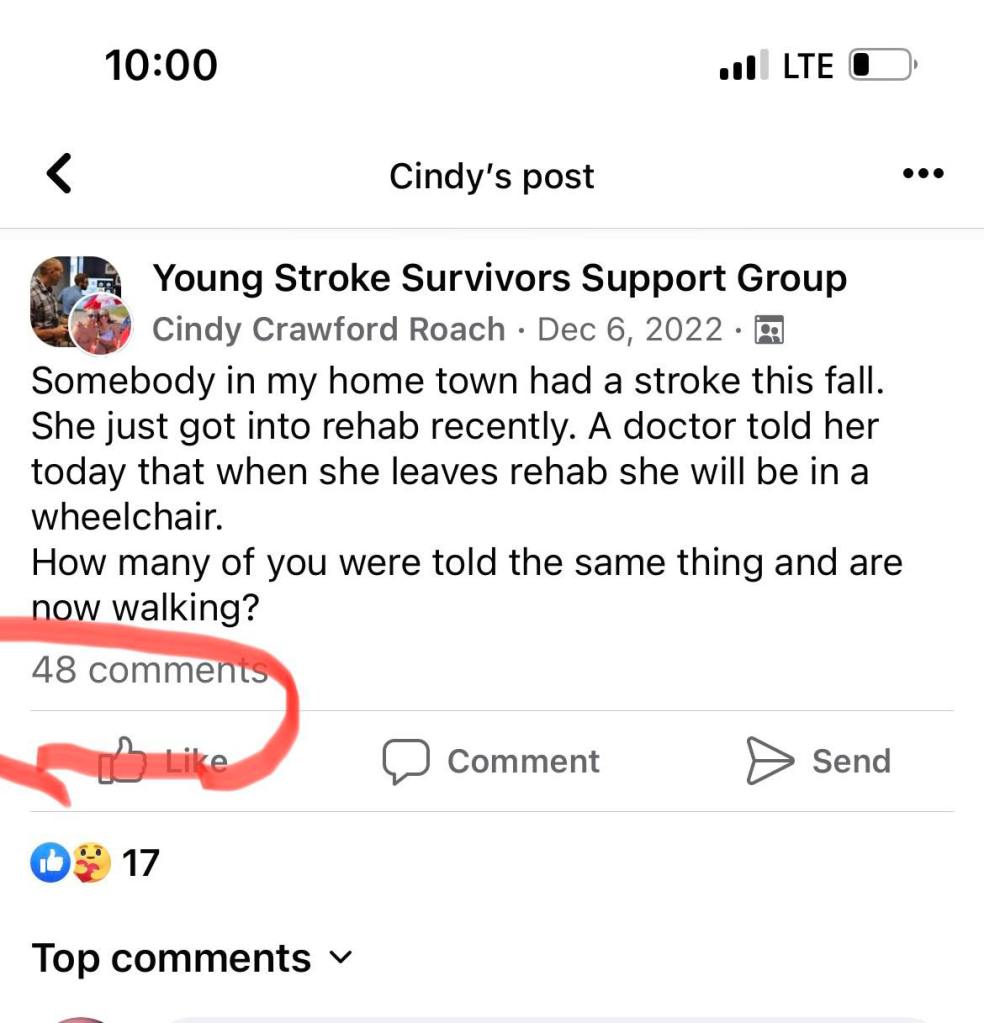

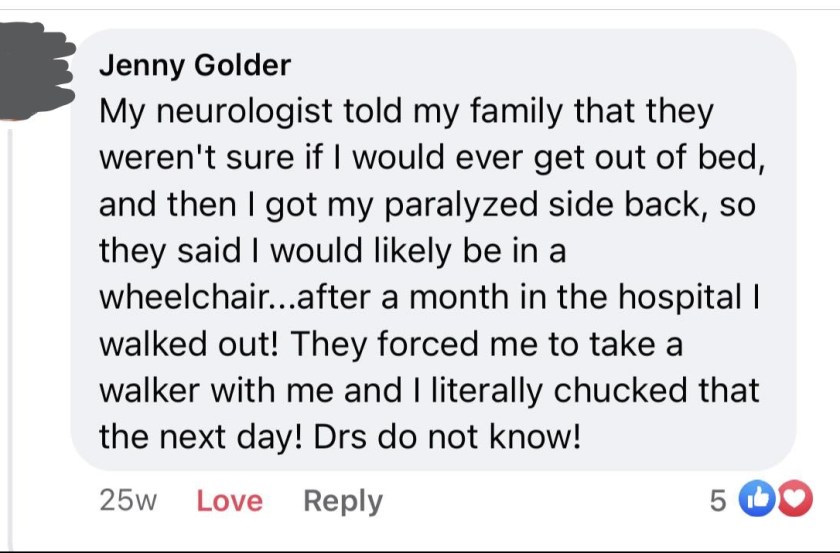
She is walking with a cane now and recently tossed her brace. She is NOT in a long-term care facility! Can you imagine if she had listened to those doctor’s words?
Most neuroplasticity rewiring comes from repetition. Levine in Stronger After Stroke says, ”Some research suggests that the magic number of repetitions needed is 2000. But that number is for just one movement. That is, in order to change the brain enough to make just one movement better, you would need 2000 repetitions.”
When I came home from the hospital, I could walk. My leg had unfrozen. My arm had no movement. I started doing an hour of arm and hand exercises every day. For some exercises I had to move my bad arm with my good arm. I thought my arm would recover quickly. My leg had, so why not my arm? Every few days I would close my eyes and have my husband hold one of my fingers. I would try to guess which finger he was holding. My stroke was November 1st and I thought I would be able to do this by Christmas. It has been a year and seven months since my stroke. I still cannot guess which finger he is holding. But I won’t stop trying. My hand may never recover properly; but maybe it will.
Recovery is hard. It is long. More rehabilitation will happen if you really want it. You have to work at it. You have to have intention.
There needs to be more doctors like Dr. Meaghan Keating, who told me I would run again. Doctors with more positivity towards stroke survivors and the wonders of the brain.
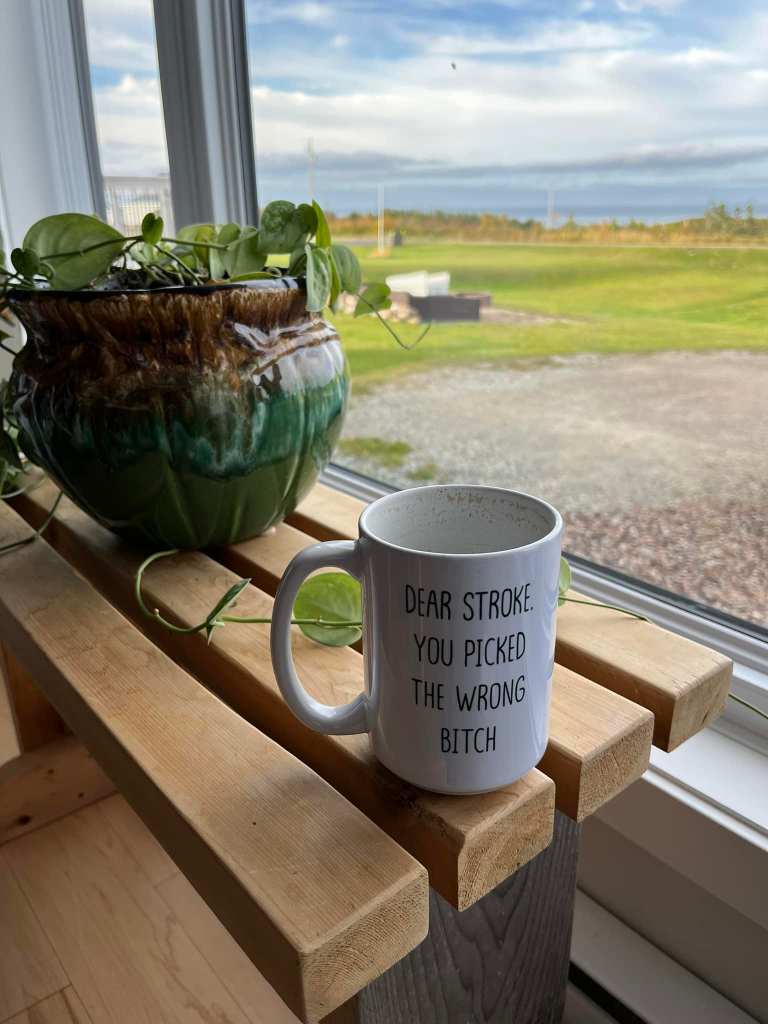
 Life: Before and After Stroke.