Neurofatigue

How to describe neurofatigue. Unless you have a brain injury, it’s almost impossible to explain.

Neurofatigue is one of the biggest and long-lasting effects of a stroke. When I was in the hospital, no one said the word neurofatigue to me. My husband, Tommy, never heard it either. The nurses would explain that extended periods of rest are expected following a stroke but never that it would be long-lasting.

The day I was released from the hospital, we stopped at Walmart. We were only there for fifteen minutes, but the exhaustion that followed was indescribable. The fatigue that followed my stroke was debilitating, forcing me to nap after even the simplest tasks, like showering or vacuuming a single room.

Soon after my stroke, a person said to me that if I didn’t stop napping, I would become dependent on them. I knew from what the nurses told me that this was normal, so I started googling. This is where I learned about neurofatigue.

My speech therapist connected me with another young stroke survivor on Cape Breton Island, and she gave me the following links:

https://www.stroke.org.uk/sites/default/files/fatigue_after_stroke.pdf?fbclid=IwAR2e6IK9tpUSTcUPwzRMJeSTloc8MVx-9lk01uausczT1eu5_H1puv1PWQ4

https://www.brainline.org/article/recovering-mild-traumatic-brain-injury?fbclid=IwAR0afg6wrjKHKR5ckuxOLsHU_I2s1K15a4GEmF3S5G7I331cH4Mw8YVV7ao

I sent these to anyone who I felt needed to know.

Unfortunately, resting is part of recovery. Almost 2 years after my stroke, if I don’t have one nap per day, I can’t fall asleep that night. My brain is way too over-stimulated to rest, leading to a weird feeling of anxiety.

So far, neurofatigue has limited how far I can drive. After 45 minutes, I have to turn the wheel over to another driver, and my brain is depleted for the day. I can’t talk properly, lose words, find it hard to complete a sentence. This is frustrating. Living in a rural area, when my partner is working out of town, I must find individuals to drive us to appointments such as the dentist and orthodontist, which are more than an hour away. When my daughter plays sports out of town, I cannot take turns driving. I can no longer jump in the car and head to Sydney or Halifax for shopping, to pick someone up at the airport, or to visit friends and relatives.

Meeting in a group does NOT drain my brain. Meeting one on one does. A friend was visiting town recently, and we hung out by ourselves on two occasions. I thoroughly enjoyed our time together, but my neurofatigue hit me much sooner on those days. (Sorry friend…it’s not you…it’s me! 😉)

Recently, my teenage daughter has been wanting to talk in the evening. Wanting to talk to ME! Isn’t this every mother’s dream? At that time of day, I am mentally exhausted and can barely articulate a coherent thought. The other night I told her to come find me earlier in the day, so we can actually have a proper conversation.

When I decided to write this blog topic, I tried to find the perfect quote that illustrates neurofatigue. From the standpoint of a stroke survivor, I couldn’t find one that truly fit. I put this post on the Young Stroke Survivors Facebook group:

I am writing a blog post about neurofatigue. The explanations I find describing neurofatigue just don’t cut it. How would YOU describe it?

There were 40 responses. Here are some of them.

Tiffany Brunner: It is like hitting a literal wall. The closer you get to it, the more you notice all your effects from the stroke. You can’t focus, you can’t think. You start making mistakes. Forgetting words, stumbling thoughts. Once you finally hit that wall. It’s a kind of tired that your eyes start to water, and there’s nothing you can do except go to sleep. Feelings of shame and guilt…depression because you can’t do what you used to do.

Reesa Fletcher: My husband says it’s like watching a cell phone battery. The battery being me. I start out strong, alert and responsive. As the day progresses, the response is slower, thinking is slower, production grinds to a halt. Inside, I feel myself in a fog. My thinking and responding is delayed. Tired, the need to shut down and sleep. It’s like being drugged. It will hit me hardest when I problem solve my day, drive, concentrate for long periods. Simple tasks that I could do before are a major daily task.

Ashley Sandler: For me, it’s a constant longing to sleep, no matter how much I’ve already slept. It’s being a lifelong mathematician and not being able to calculate simple equations. It’s being a book lover and not be able to make it through one page remembering any of the words I’ve just read. It’s reminding myself that it’s okay to just breathe when everything else just takes too much energy. The person I AM =/= The person neurofatigue allows me to be. 

Nicky Hopkins: There is no rhyme or reason to it and I can’t predict it. It just hits and it feels like whole body exhaustion – like flu without the cold. I know it’s coming when suddenly my words get muddled. The only thing that solves it is rest and sleep.

Ryan Malynn Becker: Exhaustion deep in your soul. To your core. Not sleepy, just can’t take another step tired. The battery being so drained it cannot recharge. I’ve said it before but us warriors need our own dictionary. Because tired doesn’t mean the same anymore!

I have been so fortunate with my support system. Everybody around me understands neurofatigue and my limits. My husband continues to be amazing.

Not every stroke survivor is so lucky! I see countless posts on the Stroke Facebook page of survivors who receive no compassion or understanding of neurofatigue or their recovery. Some stroke survivors are compared to other survivors by their support system.

“This person was fine after so much time…what’s wrong with you?”

“I know you had a stroke but you are home now, so get over it!”

Every stroke survivor has different deficits and different rates of recovery. Some recover fully. Most do not. Recovery takes so long. Families! Please be patient and supportive. Your stroke warriors will be grateful.

I wish I had been given a book when I left the hospital, explaining neurofatigue, auditory overload, common sensory problems at social functions, and other deficits to be aware of, along with practical suggestions or helpful tips. Maybe I will write one!

Shortlist

This summer, I submitted a poem to the Poetry in Motion program. Ten poems are selected and put on Metro Transit buses for a full year.

The WFNS website describes this year’s theme : The 2023 submission theme, “joy,” was open to broad interpretation—including happiness, delight, glee, festivity, or ecstasy; the objects, causes, or sources of joy; the joystick, the joyride, the killjoy, schadenfreude, or other complications of joy; and other meanings, qualities, and impacts of joy.

Today I received an email from one of the judges. He told that my poem had not been selected, but I was on their shortlist ! I have never entered a writing contest before, so this was a bit of a shock. I jumped up and down in the living room with my slippers on! I am thrilled to be shortlisted. (If I ever actually win a contest, I’ll probably do cartwheels on my lawn…which might be difficult with just one working arm 😉 .

Here is the poem.

Night Joy

Bright celestial blanket

A quilt

Mammoth

Wrapped around the world

Eternally

The firebugs morse code

to those in the sky.

Come From Away-A New Café!

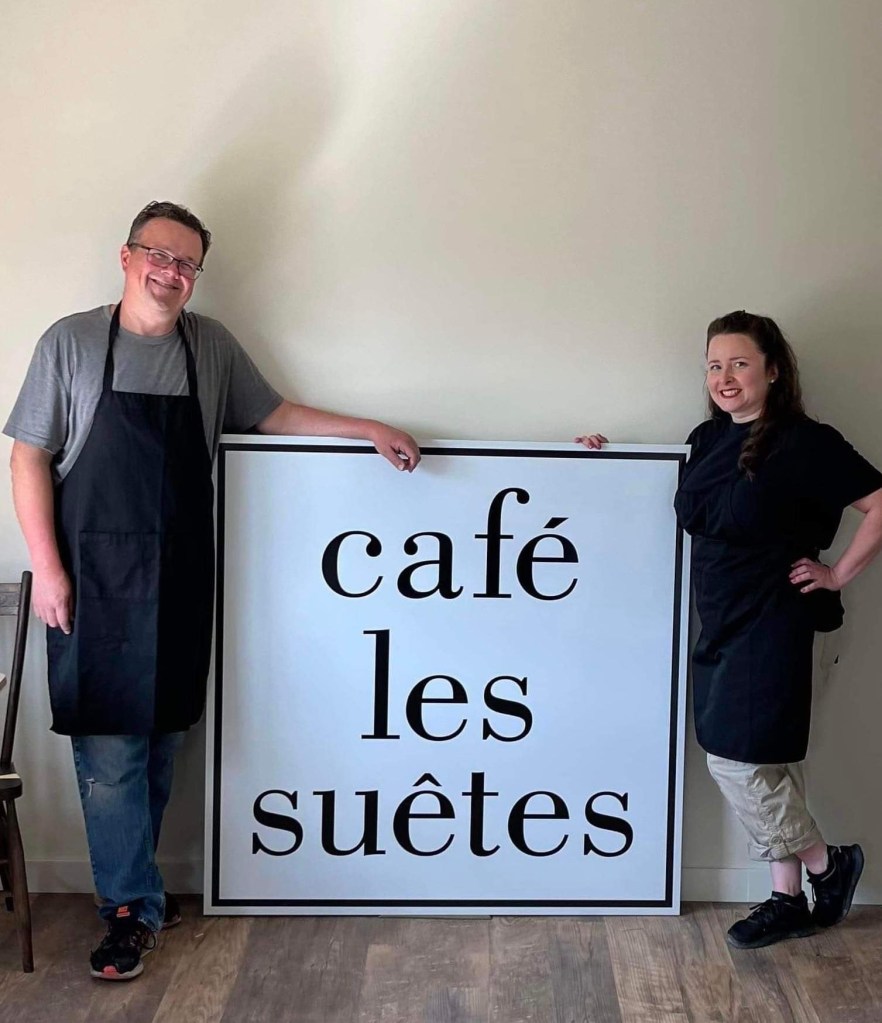
There is a new business opening in Grand Etang, Café Les Suêtes, by come from aways.

Adonia O’Hara grew up in Rhode Island, but she was born in Sydney NS, while her American parents were visiting relatives. Chris O’Hara was born and raised in Ontario.

Adonia visited Cape Breton several times as a child. When she was 16, she moved to Bay St Lawrence with her aunt and uncle, and finished high school at Cabot High. She graduated in 2000, and moved to Toronto. “I had never been to Toronto and it was wild and beautiful- full of culture and opportunity,” she said. “Collectively, I spent about 15 years in Toronto, found a group of friends, a couple of great apartments I could afford on my own, and worked in every occupation you could think of!”

She started with telemarketing, she was a Merry Maid, she sold spa packages door to door, she worked at a fabric store and finally settled into an upscale women’s shoe store where she was employed for years. She came back to Nova Scotia, and did two years at Mount St Vincent University. “I ended up leaving MSVU and heading back to Cape Breton where I worked as the Wedding & Events Coordinator at Keltic Lodge Resort & Spa for 3 years.I flourished there, and enjoyed every minute of it. For personal reasons, I left there and went back to Toronto, and got into administrative work in real estate. I went on to work in retail sales while I got my realtor’s license,” she said.

“Chris and I met 10 years ago online in Toronto. He had always wanted to eventually move to the country and open some sort of eatery, as cooking was his passion,” Adonia explained.  A few years into their relationship, Adonia took Chris to Cape Breton. He fell in love.  “The boats, and seafood, the Highlands, the hiking, the ocean, the wild berries and foraging, small town vibes, no traffic, fresh air!” she said. After this trip, they started talking about moving to Cape Breton permanently.

Chris O’Hara spent 21 years in Toronto. He worked in the advertising industry in Media Planning. Chris explained, “Simply put, my job was to ensure our clients ads were seen by their target audience. Our recommendations known as Media Plans could include a variety of media types: TV, radio, magazine, newspaper, outdoor, online, depending on which mediums were most used by the relevant consumer. Advertising was a fun and engaging career that offered many opportunities I would have not been able to experience had I worked in another career. For example, I would think it may be hard to find an accounting firm that lets all the employees leave the office on a Wednesday afternoon to cheer on the Blue Jays at Rogers Stadium while drinking $10 complimentary beers.”

Over the years he was able to move into more senior roles, with his last position being Vice President, Paid Media at a company by the name of Edelman Worldwide. “With these more senior roles came a heavy level of stress, which ultimately just burned me out and I wanted a change. I was so lucky to have a spouse that was okay with me walking away from my career,” he said.

Chris has worked a number of different jobs since they moved to Cape Breton, but the ultimate goal was always to open a food establishment. Cooking has always been an interest for Chris. He worked in some restaurants during high school and college, binge-watched the Food Network and he even enrolled in some culinary courses at George Brown College in Toronto, just for fun!

They bought a house in Grand Etang and have settled into the community. Chris joined the Lemoine Volunteer Fire Department 3 years ago and is now Vice President and also takes care of their social media accounts.

When Chris was asked how he felt about living on Cape Breton Island, he said, “I heard a quote once and I believe it rings true: Live in a place where other people want to visit on vacation.”

They had never heard about the big south east winds common to the area. The strongest winds regularly reach hurricane force, from 100-240 kilometres an hour. It only affects a 30-kilometre stretch of land. Their house is in the centre of it. The Acadian locals call these winds, suêtes.

“We bought a large, 2-story house, with 130 years behind it,” Adonia said. “The entire house shakes, rattles, and rolls when a suête comes along! Several times now, I thought the roof was going to fly off but, we’ve only had our power stack come down once! Our picnic table blew from the back yard to our neighbour’s front yard one time. We didn’t even realize it until the next morning. Truth be told, I have always loved the wind! Sounds corny but, I feel like it was fate that we moved here. And obviously, we thought it fitting that the cafe be called Café Les Suêtes!”

The locals are excited about it!

Christina Murphy, who lives down the road, cannot wait for a café so open so close to home. “I often think of how much potential there is between the villages of St Joseph Du Moine, Grand Etang and further towards Terre Noire to the Belle Cote area. There is no reason to NOT have a cafe in the area. The population continues to grow with people from everywhere, and many, I am sure would love to have a place to go to relax without having to drive to Cheticamp or NE Margaree, I wish them the greatest success,” she said.

A resident of Grand Etang, Leandre LeBlanc said, “I think it’s a great idea; I am anxious to go for a walk and a coffee.”

Local business owners support the new establishment. Geoff Gillstrom, who owns the Cedar Peak Airbnb in Grand Etang said,” It’s exciting to see people trying new things and servicing our small community with fresh ideas. I’m most elated knowing that I can now grab a quick bite on my daily walk instead of having to drive to Cheticamp. I really hope they succeed!”

 Waves End RV Campground is pleased that more businesses are opening in the area. “This is a sign that the local tourism ecosystem is recovering and thriving,” said owner Scott MacPherson.

Café Les Suêtes will be opening soon with a rotating menu including sandwiches, salads, soups, baked treats and espresso drinks.

Best of luck to these come from aways and their new café!

Published in The Inverness Oran, June 21,2023

Doctor’s Words

A doctor once said to me, “You will run again.”  This was 10 days after
my stroke. During the next many months of healing, I never forgot those
words. I did run again.

Doctor’s words are powerful.

When an ICU doctor told my family my brain was very damaged and I might not recover, they took his words very seriously. My sister went into this doctor’s meeting thinking, “This is where we find out everything.” His words were incorrect.

I am not saying doctors cannot be mistaken. But when it comes to the stroke survivor’s brain, it seems that so many doctors say the wrong thing. The brain can do amazing things. Doctors should learn about stroke rehabilitation in the 21st century.  Doctors should learn about neuroplasticity.

Wiki says:

Neuroplasticity, also known as neural plasticity, or brain plasticity, is the ability of neural networks in the brain to change through growth and reorganization. It is when the brain is rewired to function in some way that differs from how it previously functioned. These changes range from individual neuron pathways making new connections, to systematic adjustments like cortical remapping.

https://en.wikipedia.org/wiki/Neuroplasticity

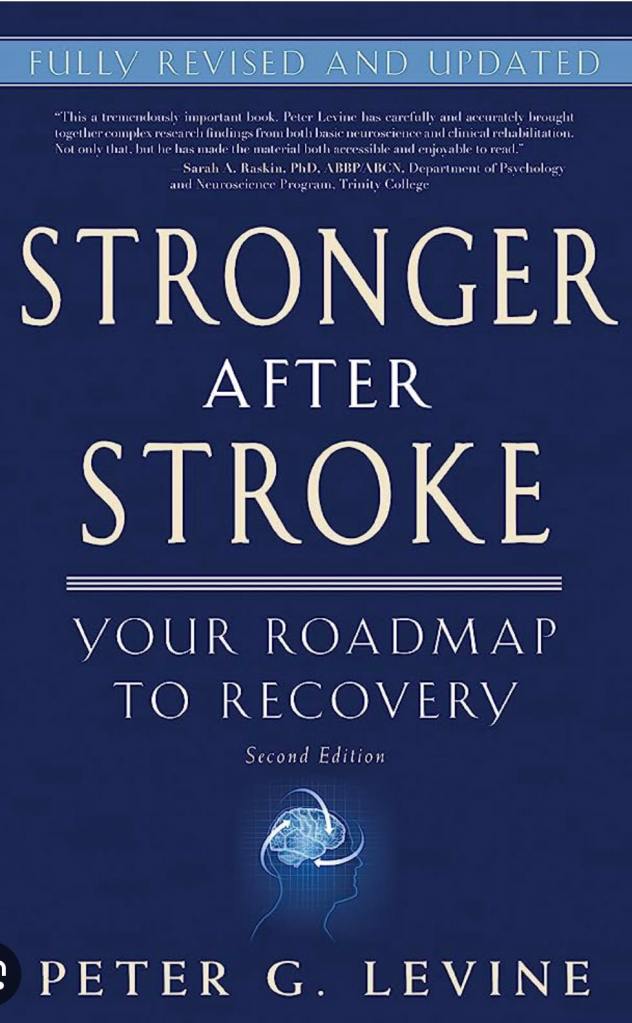
In the book Stronger After Stroke, author Peter G. Levine says:

“- There are approximately 100 billion neurons (nerve cells) in the brain.

  – A typical stroke kills less than 2 billion neurons. “

That leaves us with 98 billion neurons! 98 billion neurons to rewire and make different connections so that we can talk, walk, recover.

I have heard many doctors and health care professionals say that stroke recovery ends after three months or six months or one year. Doctor’s words. This is entirely untrue.

Seven months after my stroke, I was lucky enough to find a stroke group on Facebook. I wish I had found it sooner! People from all over the world talk about their struggles, their victories; about all things related to stroke and recovery.

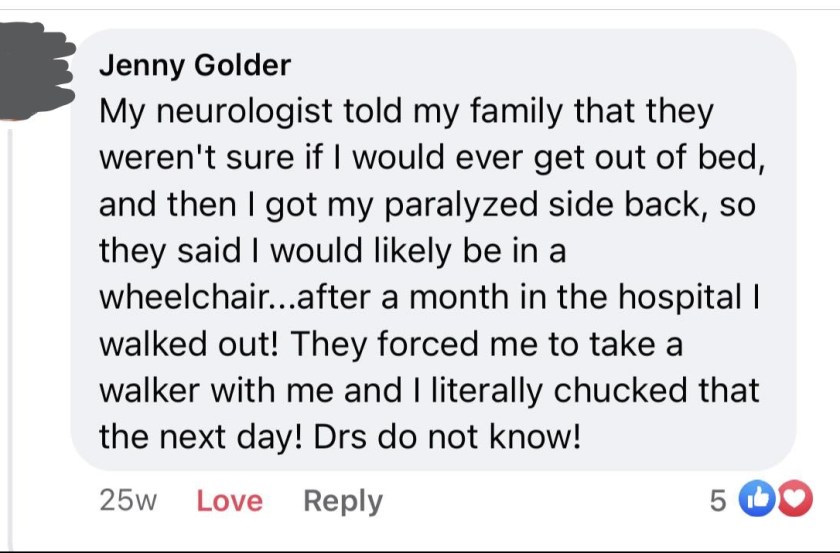
One member said that after six years, he woke up and he could feel his previously paralyzed hand. So many members were told they would never walk again. If a stroke survivor is told they will never walk again, what is going to make them try to walk again? Doctor’s words.

Many patients who are told these things, after three months, 6 months or a year, lose hope. The survivors think, this is it for me, I cannot get any better after these milestones.

A year after my stroke, I made contact with my speech therapist again. I had started work in August, and I felt that I had made little progress with my speech since I started to work again. I remember going shopping with my daughter for her school clothes in September. I was talking to sales ladies and I sounded drunk. I h a t e d that. I wanted to wear a big sign saying, my speech problems are stroke related! I had a zoom call with a new speech therapist. This was the second time I cried because of my stroke. I thought this was the end of my speech progress. How could I work and stay professional if people thought I was drunk or if they slightly cringed when I talked? My speech therapist’s thoughts were that maybe I was not progressing as much because work made me more tired or maybe I had plateaued for now. She never said I would not improve. Doctor’s words.

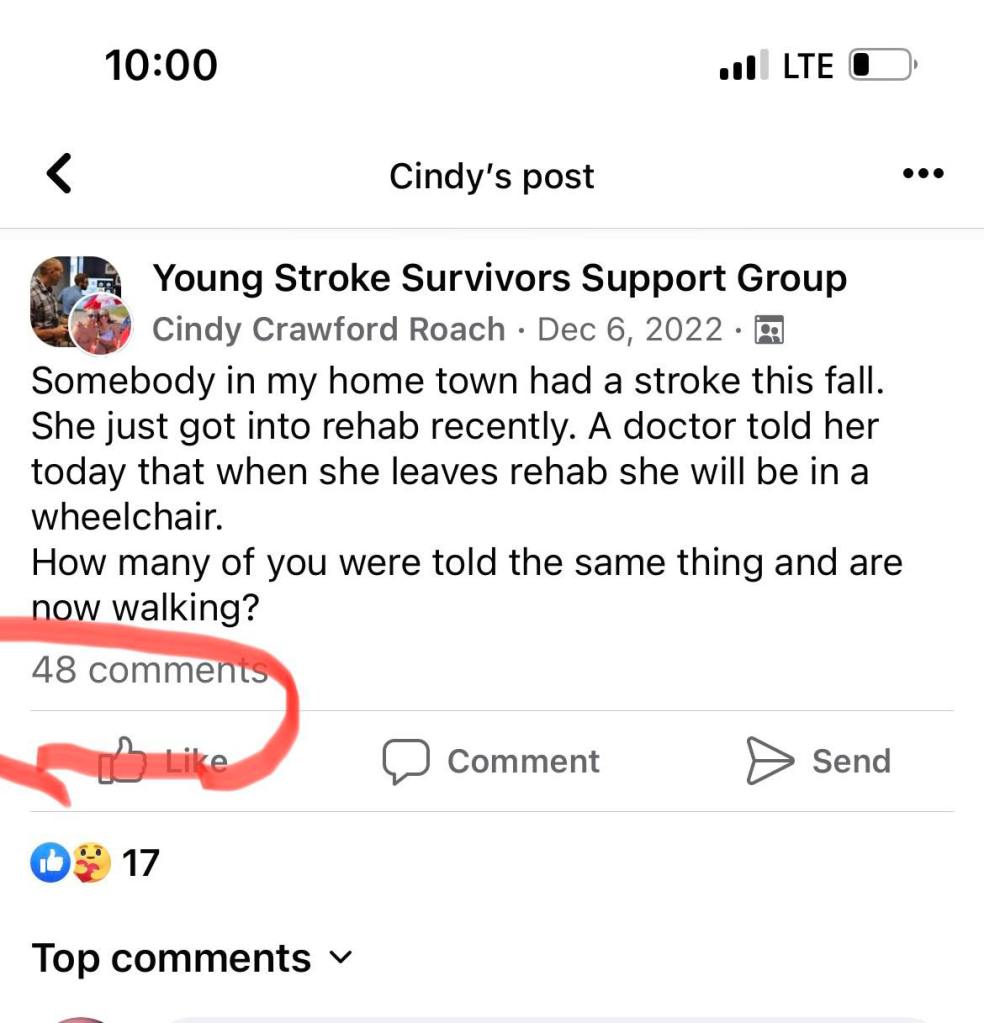
A person in my hometown had a stroke almost a year after mine. She was in hospital for two months until there was room for her in rehab. Her whole right side was still paralyzed. I reached out to her. She told me her doctor in the rehabilitation hospital told her that she would be in a wheelchair for the rest of her life and that she should start looking at long-term care facilities!

I immediately posted this on my Facebook stoke group. Within fifteen minutes I had at least thirty responses.

She is walking with a cane now and recently tossed her brace. She is NOT in a long-term care facility! Can you imagine if she had listened to those doctor’s words?

Most neuroplasticity rewiring comes from repetition. Levine in Stronger After Stroke says, ”Some research suggests that the magic number of repetitions needed is 2000. But that number is for just one movement. That is, in order to change the brain enough to make just one movement better, you would need 2000 repetitions.”

When I came home from the hospital, I could walk. My leg had unfrozen. My arm had no movement. I started doing an hour of arm and hand exercises every day. For some exercises I had to move my bad arm with my good arm. I thought my arm would recover quickly. My leg had, so why not my arm? Every few days I would close my eyes and have my husband hold one of my fingers. I would try to guess which finger he was holding. My stroke was November 1st and I thought I would be able to do this by Christmas. It has been a year and seven months since my stroke. I still cannot guess which finger he is holding. But I won’t stop trying. My hand may never recover properly; but maybe it will.

Recovery is hard. It is long. More rehabilitation will happen if you really want it. You have to work at it. You have to have intention.

There needs to be more doctors like Dr. Meaghan Keating, who told me I would run again. Doctors with more positivity towards stroke survivors and the wonders of the brain.

For those fellow stroke survivors or family members, here are some good resources:
There are lots of Stroke Survivor Groups on Facebook; joining one made a world of difference to me.

Running After Stroke

I landed at the QE11 on November 1,2021 and then four days later, after a five-hour bumpy ambulance ride, I arrived at the Cape Breton Regional Hospital. 

There was a lot going on with me. I still had an NG Tube (this is how they were feeding me). I was making tiny sounds. My right side was paralyzed, but I was starting to move my leg. I had never taken a prescribed pill before. Now I was taking whatever the doctors gave me. 

My husband showed up with my phone and some clothing. Because of Covid-19 restrictions, I could only have him as a visitor. Earlier in the Covid-19 pandemic, they prohibited patients from receiving any visitors, even if they were dying. I considered myself very lucky. 

I changed out of my hospital gown. That was a luxury. I checked my messages on my phone and tried to answer but I still could not write…I had to answer with emojis. I slept almost all the time. Neurofatigue is real; it is still very real a year and a half later.

I arrived late on a Friday, so there was not much going on during the weekend. They had me move from my bed to a chair several times a day and by Sunday, I was feeling my entire leg.

On Monday, my physiotherapist came. She had me walk the halls with a walker. I did three rounds. My arm was still hanging there, paralyzed, unresponsive. I was sitting on my hand by accident for long periods of time. I had to be extra careful that I did not get it caught anywhere. 

Two days later, I graduated to a cane. The next day, I was doing one of my regular walks up and down the hall, and I noticed my physiotherapist watching me from the nurse’s station. She came to my room later and asked me to go for a walk. We walked out of the stroke unit and down some halls until we got to a large lobby with a stand-alone staircase in the corner. She asked me to climb up and down the stairs. Then she took my cane away and had me do it again. From this point on, I was cane-free!

Several doctors met with me. I was starting to talk a little. I had aphasia and dysarthria. I asked them how long it would take to recover from my stroke. They said at least a year. My stroke has only caused me to cry on three occasions. That was one of those times. 

During my walks around the stroke unit, I noticed a room full of what looked like exercise equipment. I kept wondering when they would take me there; I wanted to rebuild my strength. Dr. Meaghan Keating told me it was just a storage room with random equipment, which really disappointed me. I told her I was a runner. She gave me some extra exercises to do in my room. She also told me I WOULD run again. I never forgot her words.

I was home by mid-November. On December 22, I had a blood clot in my brain. It came from the same artery as my dissection; it wasn’t healed yet, so some blood scraped off and landed in the same spot on my brain that was damaged by the stroke. This put me way back on so many levels. I stayed overnight in the hospital and they sent me home. They put me on real blood thinners instead of baby aspirin; forever, they told me.

I had an occupational therapist, and a physiotherapist come to my home once a week. My arm was slowly waking up. I was doing an hour of arm exercises every day. After my exercises, I had to rest. After visits from the therapists, I had to rest. After a shower, I had to rest. For me, neurofatigue is one of the worst conditions left by the stroke, even more frustrating than my maimed right arm. My speech problems are super frustrating as well. 

After months of arm exercises and resting, I managed to do 15 push-ups. My right arm was shaking like crazy, but I did it. 

Two days later, on June 16th, I went on my first run since my stroke. My husband waited by the phone because I was not sure I could do it. I ran 5km. I was elated. 

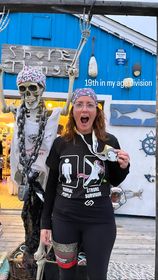
That same day, I booked myself into my first race ever. Just because I could. The 5km Sunset race at the Maritime Race Weekend in Halifax. I convinced my cousin to run with me. She is not a runner! My sister came too; this was not her first race, so at least someone knew what was going on. We picked pirate names and bought pirate bandanas. 

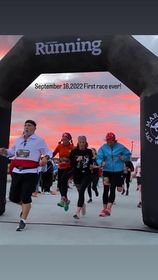
I ran all summer. September 16th,2022 was our race day. It was freezing. I did my best time ever since my stroke and 19th out of 158 in my age division. 

It has been 1 year and 7 months since my stroke. I am in speech therapy. Neurofatigue is an issue, but not nearly as bad as before. I nap once a day. My speech gets worse when I am tired and I cannot drive long distances. My right side, from the top of my head to the tips of my fingers, is mostly paralyzed. 

I am still running. 

For those fellow stroke survivors or family members, here are are a couple of good resources:
There are lots of Stroke Survivor Groups on Facebook; joining one made a world of difference to me.

A Patient With No Voice

On November 1st, 2021, I had a stroke. I was 50 years old and healthy. I ran regularly, did Pilates, took zero pills. My stroke was due to a carotid artery dissection.

My husband found me an hour later. The stroke stole my speech and the right side of my body was paralyzed. The ambulance took me to Inverness hospital to be given the clot buster medication. 

The paramedics talked to me; the nurses talked to me, the CT Scan Technologists talked to me. My family showed up. They talked to me. 

The nurse who gave me the clot buster medication told me, “This is a dangerous medication. People have died in this very room after taking it. Do you consent to it?” I could not talk, but I nodded. I knew this medication could save me. 

 Isn’t this what healthcare is supposed to do? Talk to patients? Tell them what is going on? What is about to happen? Try to communicate with a patient?

The clot buster medication did not completely work, so the medevac came. During my time in the helicopter, I thought of my family and tried not to think of my right side, which wasn’t working. I could not believe this was happening to me. When the helicopter landed after such a short time, I thought I was in Sydney. Nobody told me I was in Halifax. I was awake, in a wheelchair, but I could not make a sound. 

They brought me to what I now know was the emergency department. They placed me in a room by myself which connected to a room full of nurses, divided by windows.

It was now close to suppertime. I had not gone to the bathroom for many hours… pre-stroke. I really had to urinate. Two people came into my room. I could not speak. With my good hand, I pointed at my stomach area more than once. How else was I going to communicate this? They both saw me, but neither person said a word to me. One person said to the other, “We are not going to be able to do what they wanted. We will have to take her now.” I am sure they thought I was losing it; I was just trying to communicate.

They pushed my wheelchair down a hall. I kept looking for bathroom signs so I could show them what I wanted. They pushed me into a room full of doctors and nurses. My heart sank. Please let me use the bathroom before they do anything else to me! I pointed to my stomach again… over and over. I was the center of attention, but again… nobody said a word. 

The QE11 is the biggest hospital in Nova Scotia, but yet nobody talked to me. I was a patient with no voice.

Suddenly, someone behind me put something over my face. I woke up later in the ICU.

Interestingly, I received a letter from the QE11, asking me for a rating of my anesthesiologist. I did not respond. The care he or she gave me was perfect. I was not sick; the meds given were the right amounts; but couldn’t SOMEONE have told me I was about to have an operation? 

When I woke up in the ICU (they had to wake me up every hour to make sure my brain was not swelling) I recognized my family members and realized I was in recovery of some sort. I did not realize I had to make signs to my family that I was mentally astute; I was heavily drugged, so that would have been almost impossible. 

The head doctor of the ICU brought my family to a room less than 24 hours after my operation. He told them a significant part of my brain was dead. My sister asked: once rehab is possible, what were my chances at quality of life? My house was in the middle of renovations; should we make it wheelchair accessible? The doctor told them I may never go home, rehab might not be possible. I understand doctors have to tell it like it is. But less than 24 hours after my surgery to be told that chances are I would not recover? Shouldn’t another doctor be present, like a neurologist, to explain that until 48 hours after surgery, it is hard to know how I fared out if this doctor could not communicate this effectively? My sister left this meeting devastated; she told my family this terrible news.

When I was more awake, my family members and a nurse were next to me talking about who my family doctor was; they had the wrong doctor. Raising my hand, I shook my head. I made them go through each doctor until they reached the correct one and gave them a thumbs up. I had no idea this simple communication meant so much.

Later, my sister mentioned we were in Halifax. I still could not speak, but she saw the look of shock on my face. “How did I get to Halifax from Sydney?” I thought. A short time later, the nurse said something about the date and I understood it was late November. I thought I had been asleep for weeks. Somehow, I asked for a pen and paper. I wanted to know the date. The nurse told me I might not be able to write. She was right. My brain would not compute any part of writing a word. This was one of the strangest feelings I ever had.

I was at the largest hospital in Nova Scotia, but yet nobody knew how to communicate with a stroke patient. Here are some solutions to these communication problems.

1) IF SOMEONE CANNOT TALK, DO NOT TREAT THEM AS IF THEY ARE UNCONSCIOUS.

 2) When I landed in the helicopter, why didn’t somebody tell me I was at the QE11 in Halifax? 

3) When I was trying to communicate, why didn’t somebody try to understand what I was saying or at LEAST tell me I was going to be operated on by some very capable doctors? 

4) Dayshift nurses in the ICU should ensure non-verbal patients are shown the location and date on the whiteboards every morning. 

5) I found a poster for Visual Communication on Etsy for $25. Shouldn’t they automatically provide something like this to all patients who cannot speak? 

Ten days later, I was walking with a cane. Four days after that, I walked out of the hospital. I can write now! My right arm and speech are still in recovery.

I sent my experience through the patient feedback email and received a letter from the Health Services Director Central Zone. She promised their team would work on improving their approach to communicating with stroke victims. She also promised to have me review this material in the coming weeks. This was a year ago.

Hopefully, their care delivery towards stroke victims has improved, to prevent some of the confusion I felt as a patient with no voice.

Published in The Inverness Oran, May 31,2023

For those fellow stroke survivors or family members, here are are a couple of good resources:

http://www.marchofdimes.ca 
http://www.afterstroke.ca
There are lots of Stroke Survivor Groups on Facebook; joining one made a world of difference to me.

Her

Born in Montreal and raised in Cape Breton, Cindy grew up by the sea. She spent her childhood jumping from rock to rock along the rugged beach with her black lab and her friends, binoculars in hand on the family-owned whale watching boat, and reading lots and lots of books. The Bobbsey Twins, Nancy Drew, Trixie Belden, Anne of Green Gables, Littlest House on the Prairie, Pippi Longstocking and anything by Madeleine L’Engle.

She moved around a bit and had many different occupations. Tour guide on the whale watching boat, T-shirt seller in Banff, bookstore clerk in Yellowknife, tree-planter in BC, oyster picker on Denman Island, English teacher in South Korea.

For most of her adult life, she had to carry identification, to prove her name really was Cindy Crawford. As a result, she published three children’s books under the name CJ Crawford. Luckily for her, she got married in 2020. Bah-bye supermodel moniker!

On November 1,2021, she had a stroke. Before 11am, she could walk and talk. After 11am, she could not. The ICU doctor told her family she might never go home. Two weeks later, she walked out of the hospital. Her speech and arm are still in recovery. She went back to work almost a year later. They would not adjust her duties to accommodate her speech issues, so after seven months she found herself, disconsolately, back on disability.

She has been writing ever since.

Come From Away

I am a come from away. 

I was born in Montreal at St Mary’s Hospital. Dr. Quinn told my father that I was a perky pipsqueak. Perhaps I was too little and lively to be raised in the big city. At 4 months old, I moved to Cape Breton. As the result of my parent’s decision, I was able to spend my childhood roaming the fields with my dog, playing games in my neighbours’ yards and roaming the seashore with my friends.

My father had ties to Cape Breton. His mother, Lucy à William, à John, à Eli, à Basile, à P’tit Basile Chiasson, was born and raised in St Joseph du Moine. She married Lloyd Crawford and raised her children in Moncton, N.B. My father loved to visit his grandparents in Lemoine.

My parents moved from New Brunswick to Quebec in 1965 as they were crying for teachers and paying them very well. Five years later, the October Crisis forced them to re-evaluate. The FLQ (Front de libération du Québec) kidnapped James Cross, a British diplomat and the provincial Labour Minister Pierre Laporte. They killed Laporte. The War Measures Act was imposed. We had an English name.

My father was a school principal and my mother had a good job; they were well established. Nevertheless, in October 1971, they loaded three kids and a dog into their vehicle and drove to Grand-Etang, Cape Breton. No house, no jobs…they were starting from scratch.

Back then, my father’s teaching certificate was no good in Nova Scotia. He got a job selling insurance, door to door. He hitchhiked to Truro during the summer months to take teaching courses. Eventually, he got a job teaching in Inverness, and then at NDA school in Cheticamp, closer to home.

In the summers, my father ran a whale-watching business, the first one in Nova Scotia. He got a lot of flack from the local fishermen for the way he awkwardly docked his boat the first few times, and for telling tourists those ”poissons bleus” were whales. Over time, people realized they were pilot whales, and now whale-watching tours operate in many ports.

He talked to countless visitors over the years, and most times he would say, ”I chose to live here.”

When I was 18, I left Cape Breton. I went to university. I lived in a multitude of places: Banff, Yellowknife, the Gulf Islands, Halifax, South Korea, Ottawa, Quebec.

In 2011, I moved back to Cape Breton. I chose to live here.

I came from away for good.  

Published in The Inverness Oran, May17,2023