

On November 1st, 2021, I had a stroke. I was 50 years old and healthy. I ran regularly, did Pilates, took zero pills. My stroke was due to a carotid artery dissection.
My husband found me an hour later. The stroke stole my speech and the right side of my body was paralyzed. The ambulance took me to Inverness hospital to be given the clot buster medication.
The paramedics talked to me; the nurses talked to me, the CT Scan Technologists talked to me. My family showed up. They talked to me.
The nurse who gave me the clot buster medication told me, “This is a dangerous medication. People have died in this very room after taking it. Do you consent to it?” I could not talk, but I nodded. I knew this medication could save me.
Isn’t this what healthcare is supposed to do? Talk to patients? Tell them what is going on? What is about to happen? Try to communicate with a patient?
The clot buster medication did not completely work, so the medevac came. During my time in the helicopter, I thought of my family and tried not to think of my right side, which wasn’t working. I could not believe this was happening to me. When the helicopter landed after such a short time, I thought I was in Sydney. Nobody told me I was in Halifax. I was awake, in a wheelchair, but I could not make a sound.
They brought me to what I now know was the emergency department. They placed me in a room by myself which connected to a room full of nurses, divided by windows.
It was now close to suppertime. I had not gone to the bathroom for many hours… pre-stroke. I really had to urinate. Two people came into my room. I could not speak. With my good hand, I pointed at my stomach area more than once. How else was I going to communicate this? They both saw me, but neither person said a word to me. One person said to the other, “We are not going to be able to do what they wanted. We will have to take her now.” I am sure they thought I was losing it; I was just trying to communicate.
They pushed my wheelchair down a hall. I kept looking for bathroom signs so I could show them what I wanted. They pushed me into a room full of doctors and nurses. My heart sank. Please let me use the bathroom before they do anything else to me! I pointed to my stomach again… over and over. I was the center of attention, but again… nobody said a word.
The QE11 is the biggest hospital in Nova Scotia, but yet nobody talked to me. I was a patient with no voice.
Suddenly, someone behind me put something over my face. I woke up later in the ICU.
Interestingly, I received a letter from the QE11, asking me for a rating of my anesthesiologist. I did not respond. The care he or she gave me was perfect. I was not sick; the meds given were the right amounts; but couldn’t SOMEONE have told me I was about to have an operation?
When I woke up in the ICU (they had to wake me up every hour to make sure my brain was not swelling) I recognized my family members and realized I was in recovery of some sort. I did not realize I had to make signs to my family that I was mentally astute; I was heavily drugged, so that would have been almost impossible.
The head doctor of the ICU brought my family to a room less than 24 hours after my operation. He told them a significant part of my brain was dead. My sister asked: once rehab is possible, what were my chances at quality of life? My house was in the middle of renovations; should we make it wheelchair accessible? The doctor told them I may never go home, rehab might not be possible. I understand doctors have to tell it like it is. But less than 24 hours after my surgery to be told that chances are I would not recover? Shouldn’t another doctor be present, like a neurologist, to explain that until 48 hours after surgery, it is hard to know how I fared out if this doctor could not communicate this effectively? My sister left this meeting devastated; she told my family this terrible news.
When I was more awake, my family members and a nurse were next to me talking about who my family doctor was; they had the wrong doctor. Raising my hand, I shook my head. I made them go through each doctor until they reached the correct one and gave them a thumbs up. I had no idea this simple communication meant so much.
Later, my sister mentioned we were in Halifax. I still could not speak, but she saw the look of shock on my face. “How did I get to Halifax from Sydney?” I thought. A short time later, the nurse said something about the date and I understood it was late November. I thought I had been asleep for weeks. Somehow, I asked for a pen and paper. I wanted to know the date. The nurse told me I might not be able to write. She was right. My brain would not compute any part of writing a word. This was one of the strangest feelings I ever had.
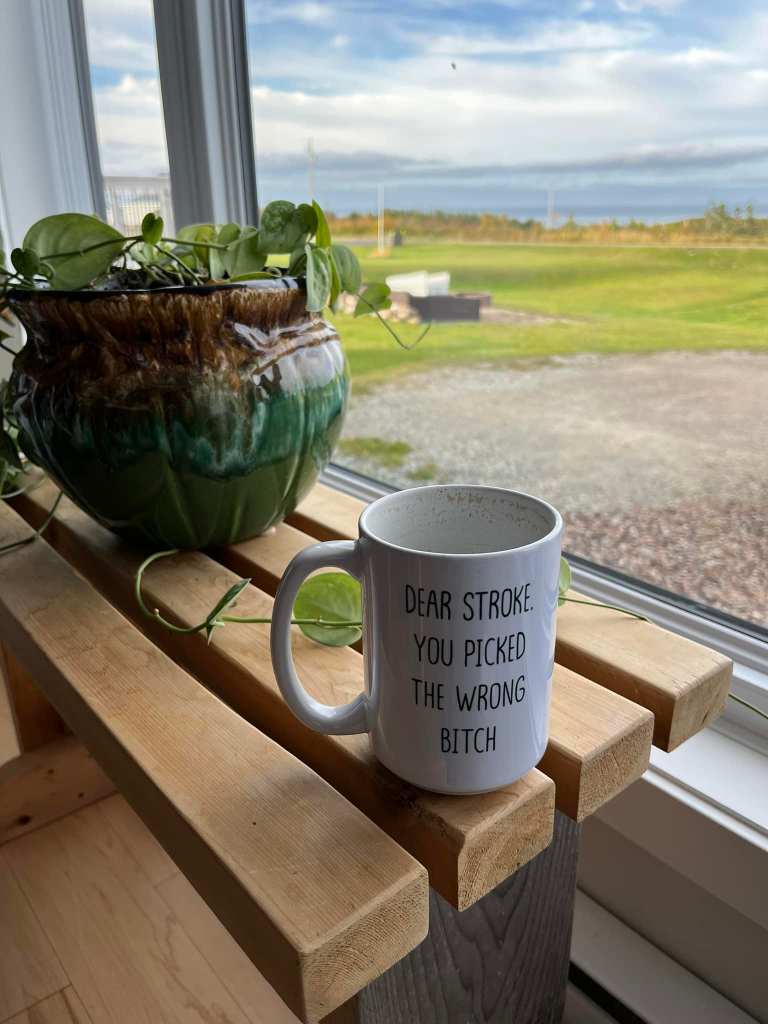
I was at the largest hospital in Nova Scotia, but yet nobody knew how to communicate with a stroke patient. Here are some solutions to these communication problems.
1) IF SOMEONE CANNOT TALK, DO NOT TREAT THEM AS IF THEY ARE UNCONSCIOUS.
2) When I landed in the helicopter, why didn’t somebody tell me I was at the QE11 in Halifax?
3) When I was trying to communicate, why didn’t somebody try to understand what I was saying or at LEAST tell me I was going to be operated on by some very capable doctors?
4) Dayshift nurses in the ICU should ensure non-verbal patients are shown the location and date on the whiteboards every morning.
5) I found a poster for Visual Communication on Etsy for $25. Shouldn’t they automatically provide something like this to all patients who cannot speak?
Ten days later, I was walking with a cane. Four days after that, I walked out of the hospital. I can write now! My right arm and speech are still in recovery.
I sent my experience through the patient feedback email and received a letter from the Health Services Director Central Zone. She promised their team would work on improving their approach to communicating with stroke victims. She also promised to have me review this material in the coming weeks. This was a year ago.
Hopefully, their care delivery towards stroke victims has improved, to prevent some of the confusion I felt as a patient with no voice.
Published in The Inverness Oran, May 31,2023
For those fellow stroke survivors or family members, here are are a couple of good resources:
 Life: Before and After Stroke.